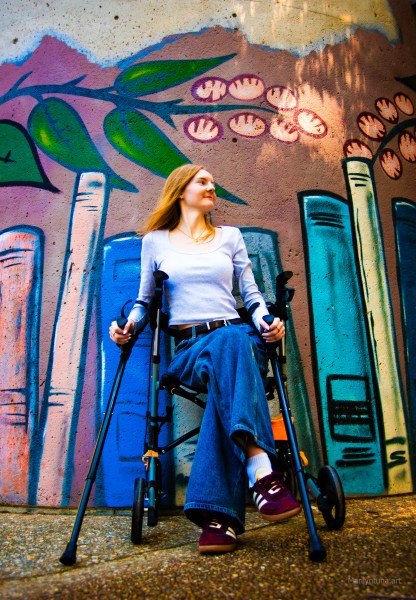
Rika Jammer
Tell us a little about who you are and what brought you here.
I’m Rika, I’m a Canberra based architecture student and designer for the student magazine. I met Marilyn through a group art exhibition “What did they tell you?” in Sydney in January 2025. In January 2020 when I was 15 I became sick with what I thought was a bad flu, after many weeks and months of my walking becoming more unsteady, and struggling everyday with pain, numbness and dizziness despite having normal test results I was diagnosed with FND (Functional Neurological Disorder). In August 2022 I was admitted to hospital, where I stayed for six months relearning how to stand, walk and eat. Just as a baby might learn to walk, I learned how to put one foot infront of the other, how to chew, swallow, breath, stand and roll myself around in my wheelchair enough to get discharged and start my final year of school. In December 2023 I graduated year 12 and took my first steps without help from a wheelchair, walker, crutches or cane.
What invisible or visible part of your story do you wish more people understood?
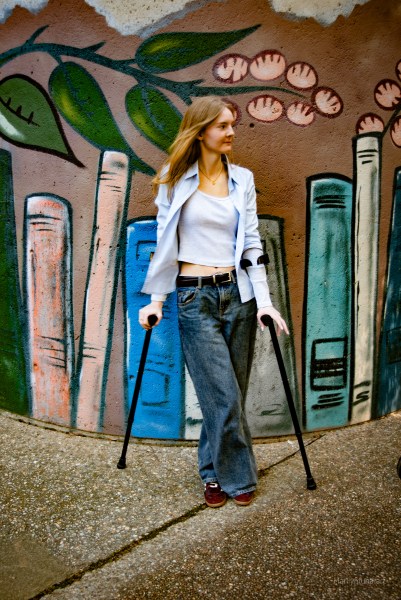
FND is one of the most common presentations to a neurologist, the reason you haven’t heard of it like you have heard of migraines or epilepsy is that no one talks about it. Its described as a disconnect between the brain and body causing symptoms like weakness, tremors, pain and issues with balance and coordination. The condition has had many names, and its often misunderstood as being a psychological condition, and that patients are faking it or ‘putting it on’, as tests for physical disease process almost always come back normal. Its likely you know or have known someone with experience of this condition, a lack of awareness and understanding makes it hard to explain why severe physical symptoms can occur without physical disease, people can understandably be ashamed and confused when reciveing and FND diagnosis. Theres no community, no fundraisers and no awareness of this very common condition, instead you might leave the doctors appointment with the FND website and a referal to a psychologist and (if you’re lucky) a physiotherapist.
How did it feel to be photographed as part of Desire Lines?
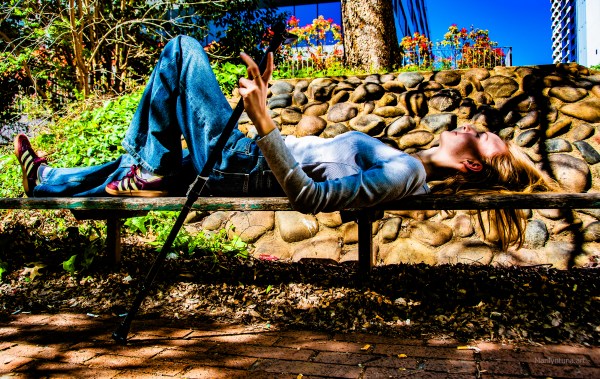
It was empowering, it felt good to carry my walker and crutches around without actually using them. I realised I had strength in my legs and stamina to walk, my old mobility aids had once kept me on my feet and allowed me to go to school, now they were a symbol of how hard I fought to be where I am now.
Do you have anything else you would like to add?
Not every struggle is visible, not even on MRI’s and blood tests.
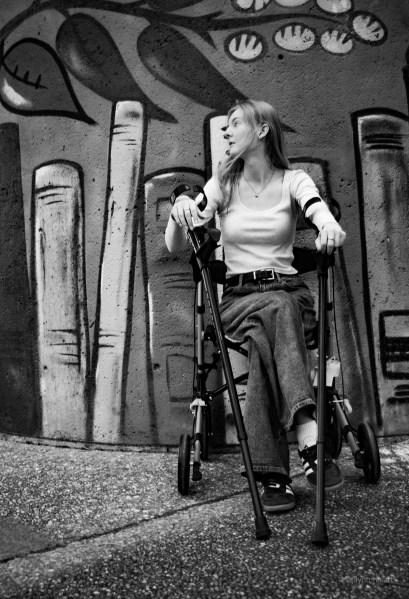
This art is not for sale.
People’s pain and hardship cannot be commodified in this space. This space exists simply to inspire anyone who is struggling to cope or searching for a way through.
The art is a gift from myself and every participant. These images capture a moment in time that allowed us to realise that our pain has given us something priceless:
Wisdom and resilience.
They form the desire lines we walk as we move through each new storm we face, again and again.

 marilyntuna.art